My Child's First Earning System

My Child's First Earning System · Ages 4–16

Stop Giving your kids money Teach them to earn it

A done-with-you family system that builds the kid, not just the habit. Real work, real money, and the responsibility, patience, and confidence to back it up.

You already know money skills matter. What's harder to find is a system that teaches them at home - without turning every conversation into a lecture. This guide gives your family a weekly structure where your child chooses real work, earns real money, and learns what to do with it. Share first. Save toward something. Spend what's left - and wait overnight before you do.

Seven character habits. One fridge list. Starts this weekend.

30-day money-back guarantee — if it doesn’t click for your family, you get a refund

Instant PDF download · Ages 4–16 · No app, no subscription · Print and start this weekend

My Child's First Earning System - complete printable PDF guide with gig menu and $20 plan worksheets
Get the System - $9
Get the System - $9

See Exactly What You’ll Print and Use This Weekend

Everything is designed to be simple, practical, and ready to use. Just print the pages, follow the system, and start teaching real money skills at home.

Stop Giving Your Kids Money — Teach Them to Earn It

Stop Giving Your Kids Money — Teach Them to Earn It

Stop giving your kids money — teach them to earn it instead. This guide shows you exactly how to set up a simple earning system at home.

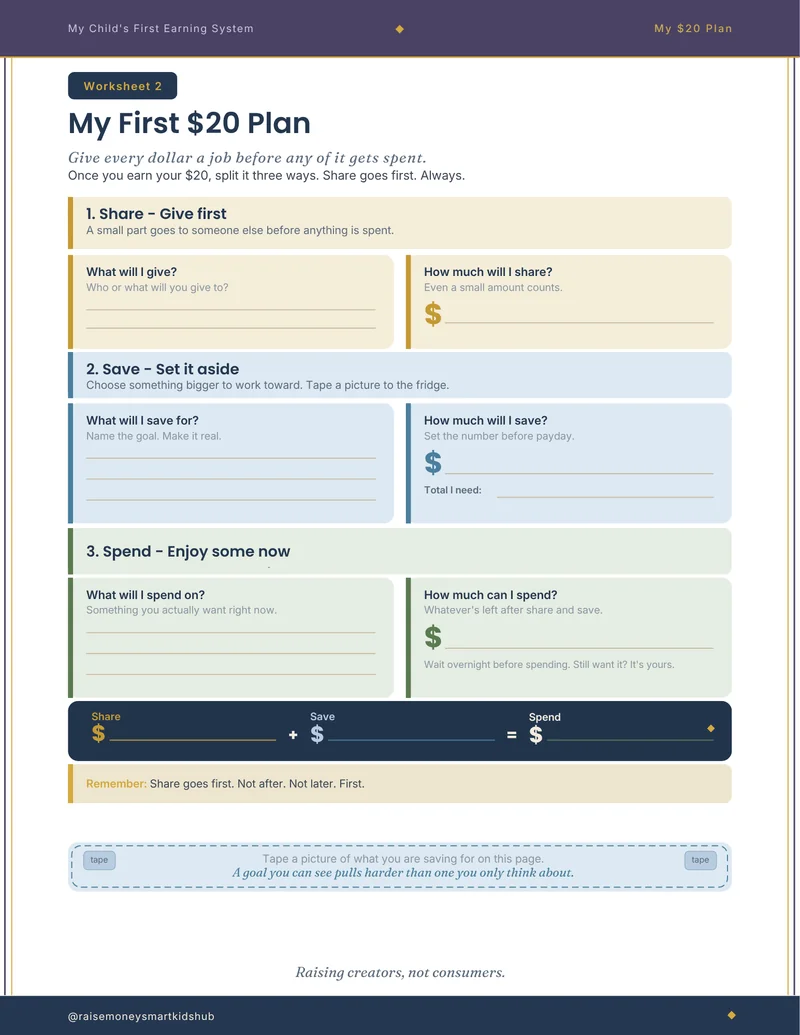
My First $20 Plan

My First $20 Plan

Help children connect effort to rewards. Share goes first, save comes second, spend comes last — every single time.

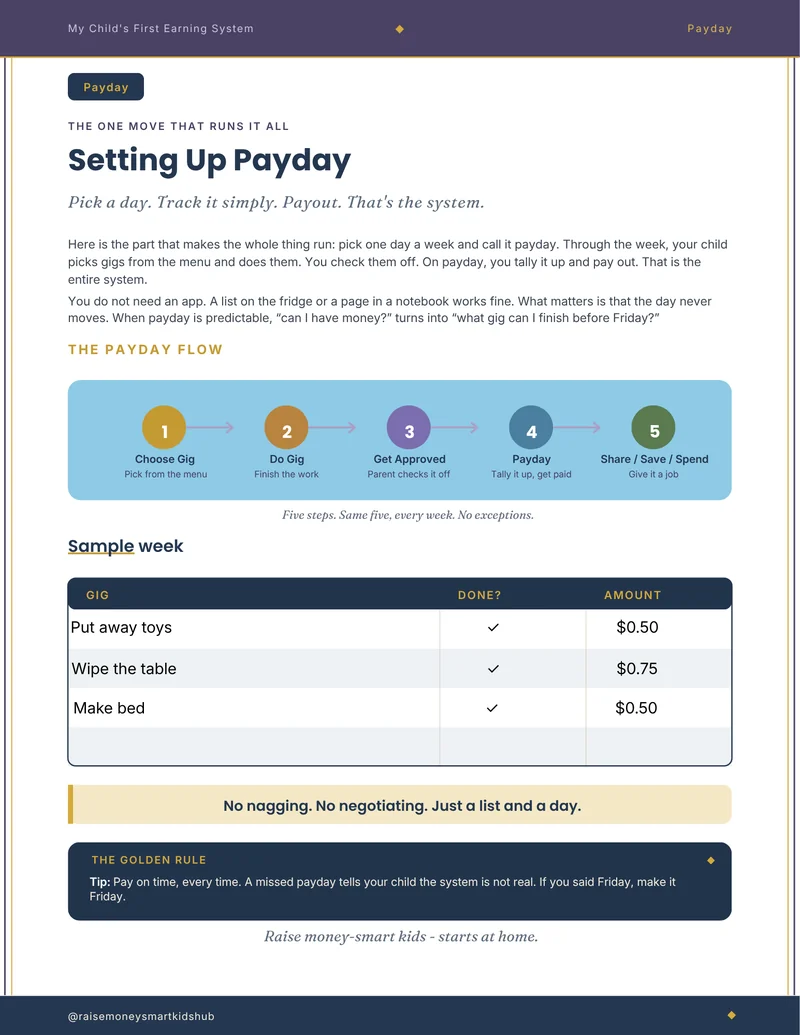
Setting Up Payday

Setting Up Payday

The complete 5-step system with a sample week showing real gigs and dollar amounts. No nagging. No negotiating. Just a list and a day.

Plus additional guidance, examples, setup instructions, and family implementation tools to help you get started immediately.

3 Age Tiers
5 Step System
7 Habits Reinforced
10 Parent Scripts

Real Parents. Real Results.

What People Are Saying

“Honestly, I was sceptical that this would work at all. We were drowning before this. Every week it was the same thing nagging the kids to do chores, them rolling their eyes, everyone frustrated. I picked up this book, and I wasn’t expecting much. Within a few days of actually setting up the system, we saw the difference. The kids started choosing their own jobs instead of us reminding them. And then the weirdest part - they actually cared about doing them well because they knew exactly how much they’d earn. My oldest came to me asking if there were more jobs available. My oldest, he used to complain about many things. It’s been about a couple of weeks now and I’m genuinely shocked at how much more responsible they’ve become. They’re thinking about money differently, not just asking us for stuff. Honestly, it’s working. We’re grateful. This is legitimately the only parenting book we’ve stuck with.”

Sarah Lee

Mom of two teens

Verified Purchase

“I bought this half expecting it to end up on a shelf. My thinking was that my kids are who they are, and no book was going to change that. I was wrong, and I’m glad to say it. We’ve had the gig menu up on the fridge for a while now, and it’s been simple and practical to run. What I didn’t expect was the way it builds things up in them step by step. They’re picking up real competency, they understand what earning actually is, and for the first time they’re getting a feel for how money works. None of that came from school. One moment stuck with me. My middle son got properly upset one week when one of his brothers took a gig he’d been counting on, and he had to work out a different one instead. It was hard for him at first. But watching him push through it and come out the other side more sure of himself said more to me than any chapter could. Watching his confidence grow has been the best part of all this. Recommend it to any parent.”

Abraham H.

Verified Purchase

“For a long stretch, getting our three kids to pitch in around the house came down to the same routine: I’d remind them, then remind them again, and by the end everyone was a little worn out by it. That’s the part that surprised me most. It just stopped. The gig system did what all my reminding never could. The first real change was around money. They got excited about earning their own, and the moment it was actually theirs, they started thinking twice before spending it. That was new for them. For what we paid, we got way more than we expected. It’s made a real difference in our home, and I don’t say that lightly. My youngest, who’s 8, has started reading books on his own again, something he hasn’t done for ages, and that’s huge for us.”

A. Akbari

Dad of 3 Boys

Verified Purchase

Launch Pricing: $9 gets you the whole earning system - menus, payday setup, and the scripts for when your kid tests it.

You’re Not Doing It Wrong

Sound Familiar?

Every parent we talk to is stuck in some version of the same loop. Not because they’re bad with money — because nobody ever handed them a system. See which one sounds like your house.

The ATM Parent

Your kid walks up, asks for money, and genuinely has no idea where it comes from. You’re not a parent in that moment — you’re a vending machine.

“My son asked for $20 for a video game and had no idea that meant I’d have to actually have $20 sitting around. He thinks money just... exists. In my wallet. Forever.”

— Mom of a 7-Year-Old

“He’s 15 now and still asks me for gas money like I’m an ATM. When exactly was he supposed to learn this stuff? Nobody taught me either, honestly.”

— Mom of a Teenager

The Broken System

Allowance with no accountability. Chore charts that last three weeks. You’ve tried the tools — they just don’t stick because they were never built to teach anything.

“I pay an allowance no matter what. Room’s a disaster, attitude’s terrible — Friday comes and the money shows up anyway. I know that’s backwards but I don’t know what else to do.”

— Dad of Two, Ages 9 & 12

“We tried a chore chart for about three weeks. Cute stickers, color-coded, the whole thing. By week four nobody was filling it out, including me.”

— Parent of Three

The Money Blind Spot

Birthday cash vanishes in days. Your kid can’t explain where it went. And deep down you realize — you never actually taught them. You just talked about money near them.

“My daughter got $150 for her birthday and it was gone in four days. Not on anything dumb, just... gone. She couldn’t tell you where half of it went.”

— Mom, Daughter Age 11

“I grew up broke and swore my kids would understand money better than I did. Then I looked up one day and realized I’d never actually taught them anything. I just complained about money near them.”

— Dad, Ages 6 & 13

None of this means you’re failing. It means nobody ever handed you a system — just a vague feeling that you’re supposed to “teach your kids about money” with no actual steps.

That’s the gap this fills.

Built Into Every Week

The 7 Habits the System Reinforces Every Week

Most money tools teach one thing. This system builds seven character habits at the same time - because the money lesson is never really about money.

1

Responsibility

Your child picks their gigs, does the work, and gets paid only when the job is done. No shortcuts. No handouts. The connection between effort and reward becomes physical and real.

Parent outcome

You stop being the enforcer. The system holds the standard for you.

Child outcome

They learn that their actions - not your mood - determine what they earn.

2

Work Ethic

Every gig has a start, a standard, and a finish. Kids learn that real work means seeing something through - not just starting it. Repetition builds the habit before they ever hold a job.

Parent outcome

Less nagging. They know what done looks like because it was defined upfront.

Child outcome

They build a track record of finishing what they start - at age 5, 9, or 14.

3

Initiative

The Gig Menu puts your child in the driver's seat. They choose the work. They set the goal. Instead of waiting to be told what to do, they learn to look for what needs doing.

Parent outcome

Your child stops waiting to be assigned. They start volunteering.

Child outcome

They develop a "what can I do?" mindset that follows them out of childhood.

4

Gratitude

The first dollar in every envelope goes to giving. Before saving or spending, your child practices generosity. When you earn it yourself, giving it away means something completely different.

Parent outcome

Your child starts noticing what they have instead of only what they want.

Child outcome

Giving becomes a habit, not a guilt trip - because it's built into the structure from day one.

5

Delayed Gratification

The overnight rule is simple: if you want to spend, you wait until the next day. That one rule stops more impulse decisions than any lecture ever could - and the child enforces it on themselves.

Parent outcome

Fewer "can we buy this?" meltdowns. They already know the answer is wait.

Child outcome

They learn to want something, sit with it, and decide - the single most powerful financial skill an adult can have.

6

Confidence

Every completed gig is a small proof that they can do hard things. Every payday is evidence that their effort has value. That kind of confidence doesn't come from praise - it comes from earned results.

Parent outcome

You watch your child start tackling harder tasks without being asked or reassured.

Child outcome

They stop asking "can I?" and start asking "how do I?" - because they've already proven they can deliver.

7

Basic Money Skills

Share first. Save toward a goal. Spend what's left - and wait overnight before you do. These four rules cover more ground than most adults were ever taught. Your child learns them before they're ten, through practice, not theory.

Parent outcome

Money conversations at home shift from arguments to check-ins. They already know the rules.

Child outcome

They arrive at adulthood having already managed real money, made real mistakes, and built real habits - while the stakes were still low.

Seven habits. One fridge list. Starts this weekend.

Most parenting tools fix the behavior. This one builds the character behind it.

The System

Three Steps. One Fridge List. The Begging Stops.

No apps, no subscriptions, no 90-day onboarding. Print it, stick it on the fridge, and start this weekend. Here’s the whole process.

1

Print It & Pick

Download the PDF, print the Gig Menu, stick it on the fridge. Your kid picks the gigs they want this week — hands-on work or thinking work. Five minutes, done.

Your kid chooses the work
2

They Work, You Check

During the week, your kid completes gigs from their menu. You check them off on the fridge list. No reminding, no negotiating — the menu does the talking.

Nothing left to nag about
3

Payday — Share, Save, Spend

One fixed day each week, you pay out what they earned. They split it three ways: share first, save second, spend last. The cycle starts over. No arguments.

Giving before spending — every time

That’s it. No app to download, no account to create, no curriculum to study. Print one page, have one conversation, start one payday.

Everything Inside

Here’s Exactly What You Get for $9

A 20-page printable guide with everything you need to start the earning system this weekend — gig menus, worksheets, parent scripts, and a troubleshooting guide. Nothing extra to buy.

3 Age-Tiered Gig Menus

Ready-made gig lists for ages 4–7, 8–12, and 13–16 — with both Action Gigs (hands & effort) and Brain Gigs (thinking & effort). Pick the menu that fits your child and start today.

My Weekly Gig Tracker Printable

Your child picks their gigs, checks them off as they go, and watches their money grow. Keeps the system accurate and productive week after week.

My First $20 Plan Printable

The Share, Save, Spend worksheet that gives every dollar a job before it gets spent. Share goes first — always. That order is the lesson.

Setting Up Payday Guide

The 5-step weekly flow: choose a gig, do the work, get approved, collect pay, share/save/spend. Pick one day that never moves. A sample week shows you exactly how it looks.

The Parent Script Sheet Fridge-Ready

10 exact things to say when your child tests the system — from “Can I have money?” to “That’s not fair” to “My friend gets an allowance for free.” Every answer points back to the menu, not to you.

Troubleshooting Guide

Quick fixes for the 4 situations every family hits: your child refuses every gig, does a rushed job, you forget payday, or your teen thinks gigs are beneath them. No guilt — just solutions.

Quick Reference — The Parent Script Sheet Fridge-Ready

A fridge-ready cheat sheet with 10 exact things to say when your child tests the system. Every answer points back to the menu, not to you.

Your Child’s First Customer Challenge

The optional next step: your child takes one gig outside the family — a neighbor, a grandparent, a family friend. One real “yes” from someone who isn’t Mom or Dad changes everything.

Extra Worksheet Copies

Additional Gig Menu and $20 Plan worksheets for weeks 2–4, so you never have to reprint the whole guide. Just print the pages you need.

The Complete System

20 pages  ·  3 gig menus  ·  5 printable worksheets  ·  10 parent scripts  ·  4 troubleshooting fixes

Everything for $9 — less than the cost of one week’s allowance.

Our Promise

Try It Risk-Free For 30 Days

Try the system with your family for 30 days. If it doesn't create more responsibility, initiative, or better money conversations at home, we'll refund you.

30-Day Money-Back Guarantee

1

Purchase the MY CHILD'S FIRST EARNING SYSTEM today.

2

Print it. Use it. Try the gig menu with your child.

3

If you genuinely feel the system did not help your child better understand earning, responsibility, and money habits, simply contact us within 30 days for a full refund.

No complicated forms
No hassle
No questions asked

You have nothing to lose except one more conversation about why your child wants money.

From “Can I Have Money?” to “What Can I Earn?”

Everything Your Child Needs to Learn That Work Comes Before Money

Nine chapters, two worksheets, and a script sheet for the fridge - everything that turns the asking into earning, piece by piece.

Start Here

Why This Works

The old way is ask, nag, argue, money. We flip the order so money only shows up after real work - no lecture needed, the chart does the talking.

Result: You stop being the bank your kid begs.

The Big Idea

The 3 Money Lessons Schools Never Teach

Money follows value, brains can earn too, and people pay for solutions. Three short ideas that rewire how your kid sees money showing up.

Result: Your kid notices chances to earn instead of asking.

The System

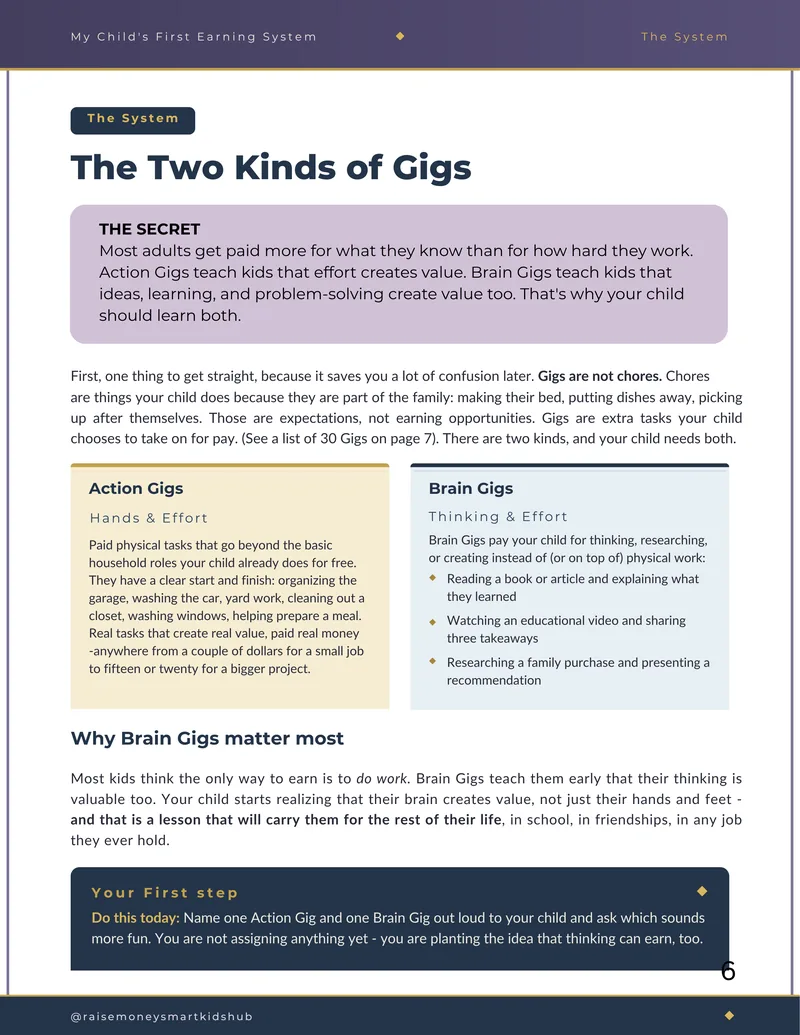
The Two Kinds of Gigs

Action Gigs use hands and effort. Brain Gigs pay for thinking - reading, explaining, researching. Your kid needs both, not just the dishes.

Result: Your kid learns thinking is worth money too.

Gig Menu

Gig Menus for Every Age

A real menu for each stage (4–7, 8–12, 13–16), with starting pay ranges already worked out so you’re not guessing what a job is worth.

Result: The menu’s already built. No guessing.

Worksheet 1

My Weekly Gig Tracker

Your kid picks their gigs, checks them off as they go, and watches their money grow. Keeps everything accurate and productive week after week.

Result: Your kid tracks the work - and watches the money grow.

Payday

Setting Up Payday

Pick one day, track it on a fridge list or notebook, pay out on time. Five steps, same five every week, no exceptions.

Result: “Can I have money” becomes “what gig can I finish?”

What’s Next

What Happens to the Money

Three jars or three envelopes. Share, save, spend. The amounts matter less than the order - share always goes first.

Result: Giving comes before spending, not whatever’s left over.

Worksheet 2

My First $20 Plan

Share, save, spend - in that order, every time. Share goes first, before a single dollar gets spent on anything else.

Result: Every dollar gets a job before it’s gone.

Troubleshooting

When It Doesn’t Go Smoothly

The refusal, the sloppy job, the missed payday, the teen who thinks gigs are beneath them - and exactly what to do in each one.

Result: One bad week doesn’t blow up the whole system.

Quick Reference

The Parent Script Sheet

A fridge-ready cheat sheet. Your kid says “that’s not fair,” you already know the line. No improvising mid-argument.

Result: You stop caving when your kid pushes back.

Level Up

Your Child’s First Customer

One gig, one person outside the family, one real yes. The first time someone who isn’t obligated to love them pays for their work.

Result: Proof - a stranger’s dollar, not just your praise.

The Final Step

You Did It

Your child earned their first $20. Not handed to them — earned. Step 1 is done. Four steps still ahead: Save Smart, Spend Wisely, Create Opportunities, Build Money Confidence.

Result: The foundation is set. Everything else builds on this.

Plus extra worksheets for weeks 2 through 4, so the system doesn’t run out after the first payday.

What Actually Changes

Here’s What’s Different in Six Weeks.

The Asking Stops

Not because your kid gives up. Because the answer is already sitting on the fridge. You stop being the one who says yes or no fifty times a week, and honestly, that alone is worth the $9.

Result: No More “Can I Have Money?”

Your Kid Actually Finishes Things

Half-done chores were never about laziness - there was no reason to finish. Once a job has a clear end point and a number attached to it, most kids surprise you.

Result: Jobs Done, Not Half-Done

Money Stops Disappearing

The share-save-spend split means there’s always a question before cash gets handed over: where’s this going. Your kid starts noticing when money leaves without a plan.

Result: Every Dollar Gets a Job

You’re Not Improvising Anymore

When they push back - and they will, that’s normal - you’ve already got the line. No more standing in the kitchen trying to come up with a fair answer while everyone’s annoyed.

Result: The Script’s on the Fridge

Your Kid Starts Seeing Work Differently

Kids who run a gig menu for a while start clocking chances to earn everywhere - a neighbor’s yard, a sibling’s homework, a garage that needs sorting. You can’t lecture that into them. It just shows up.

Result: They Spot Chances to Earn

The Fights Get Shorter

You won’t get a kid who never complains. That kid doesn’t exist. What you get is a kid who knows the rules already, so the argument is shorter and you’re not the bad guy - the system is.

Result: Shorter Arguments, Clear Rules

*This works best with consistency, not perfection. Skip a payday here and there and the system survives. Walk away from it for a month and you’re back to square one. Same as anything worth building.

The Difference

Why Most Money Lessons Don’t Stick

Many children learn to receive money. Few learn how money is actually earned.

Traditional Allowance

MY CHILD'S FIRST EARNING SYSTEM

Money is given
Money is earned
Parent decides
Child chooses opportunities
Focus on spending
Focus on earning first
Short-term rewards
Long-term habits
Often forgotten
Visible family system
Passive learning
Hands-on experience

“The goal isn’t simply giving children money. The goal is teaching them where money comes from.”

Today’s Price

Complete system - instant PDF download - ages 4 to 16

$9

one-time payment · instant download · yours forever

The full guide - all nine chapters, written for ages 4 to 16, so you’re not buying three separate things as your kid grows.
Three age-specific Gig Menus, already built. You don’t have to invent forty chore ideas out of thin air.
My Weekly Gig Tracker, so your kid can pick their gigs, check them off as they go, and watch their money grow.
My First $20 Plan worksheet - the share, save, spend breakdown, with space to write down what they’re saving for.
The Parent Script Sheet. Print it, stick it on the fridge, stop improvising when your kid pushes back.
Extra worksheets for weeks two through four, so the system has legs past the first payday.
The troubleshooting page for the four things that go wrong most - the refusal, the sloppy job, the missed payday, the eye-roll teenager.

Instant PDF delivery · Works on your phone, your printer, whatever you’re going to actually use

No Risk On Your End

Try It Once. That’s All I’m Asking.

Here’s the deal. Pick one gig from the menu. Just one. Hand it to your kid this week and let them earn their first dollar through it.

If you don’t get that little lightbulb moment, the one where your kid actually gets it, or it just doesn’t feel worth the seven bucks, email me. I’ll refund you. All of it. No interrogation, no “well did you really try it,” none of that.

I’m not worried about people abusing this. Most parents who buy something like this are tired and trying their best, not looking for a free PDF. This guarantee is for the one or two of you where it genuinely doesn’t click - and that’s fair. You shouldn’t pay for something that didn’t help.

Try one gig with your kid this week. If it’s not worth $9 to you, email me and I’ll refund it. No questions, no forms, no hassle.

Before You Buy

Questions You’re Probably Sitting With

The Reason This Matters

One Day They’ll Leave Home

One day your child will have to make financial decisions on their own.

They’ll choose what to buy.

They’ll decide whether to save or spend.

They’ll learn lessons about money somewhere.

The question is

Will they learn those lessons from debt, mistakes, and trial and error?

Or will they begin learning them today — while they’re still under your roof?

My Child’s First Earning System gives families a simple way to start those conversations now.

Get Instant Access Today

Download immediately. Print in minutes. Start this weekend.

The kind of lesson you wish someone had taught you — while you were still young enough to use it.

Get the System - $9
Get the System - $9
Get the System - $9